

Database Reactivation for Home Service Businesses: The Money Hiding in Your Old Quotes
Most shops treat a lost quote like a dead end. The customer said no, or just stopped replying, and after a couple of calls your best sales rep moved on to the next hot lead. That estimate goes in a folder and never gets looked at again. According to the guest on this episode of Wrenches n Robots, that folder is one of the most valuable assets your business has.
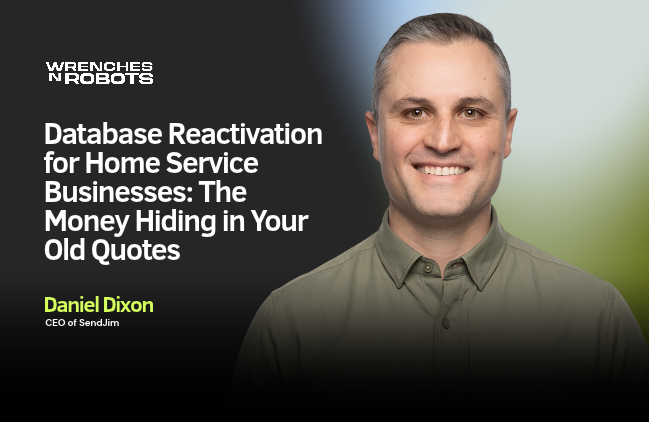
Tersh Blissett sat down with Daniel Dixon, CEO of SendJim and the owner of a multi-million dollar garage floor coating company, to talk about database reactivation for home service businesses, which is the practice of systematically following up with old quotes and past customers until they buy again. SendJim is a marketing automation platform that plugs into your CRM, reads the events already happening in it, and markets off them automatically. The theme of the whole conversation is simple: you are probably sitting on more revenue than you could get from any new ad campaign, and it is cheaper to go get it.
A no is almost never forever
The reframe that anchors the episode is this. When someone turns down a quote or goes quiet, they are not saying no forever. They are saying no right now. Daniel laid out why that distinction matters so much. Life gets in the way. They are too busy to schedule it, money got tight and they need to save up, something broke that took priority, or the price scared them and they are embarrassed to say so. None of that means the job is gone. It means the timing was wrong.
The problem is that even a great sales rep can only follow up so long before a new lead lands and pulls their attention away. As Daniel put it, by month three most reps in home service are on to the next thing. That is not a failure of the rep. It is human nature, and it is exactly the gap automation is built to fill.
$100,000 from two text messages
Daniel does not pitch this from theory. He runs a real garage floor coating company and uses it as the testing ground for what SendJim builds, so the numbers come from his own shop. Before they built the quote follow-up feature, they ran an experiment. They went back to about 300 people who had said no or stopped responding to a quote a year or more earlier, truly cold, and sent two text messages.
Those two texts sold over $100,000 of work. The texts cost him about $150. That is the whole argument for database reactivation in one story. When they systematized it, the numbers held up, and Daniel says they see north of 100 times return, roughly $100 back for every dollar put in. The mechanics are not fancy. After the rep stops getting a response, usually around month three, automation takes over with gentle check-ins at month three, month five, and beyond, mixing text, ringless voicemail, and the occasional postcard across as much as 18 months. The goal of every message is just to get the person to re-engage.
Let the rep be human, then let automation be relentless
One of the most practical parts of the conversation was how Daniel draws the line between people and automation. He wants the sales rep handling the early follow-up, because it is the most natural. A human can say the thing automation cannot, like hoping someone's spouse is feeling better, and read the conversation. So the rep runs a manual five to seven week follow-up, and then around month three the automation kicks in, and the rep knows that is the handoff.
The exact timing flexes with the business. A shop drowning in leads might only have the rep follow up for two weeks before automation takes over. A business with a long sales cycle might not hand off until month six or eight. The principle holds either way: humans do the part humans are good at, then a system makes sure nobody quietly falls through the cracks the moment the rep gets busy.
Market when the buying is hot
Daniel challenged a belief a lot of owners hold, which is that you should ramp up marketing when things are slow to smooth out the schedule. From sending millions of postcards, he says it does not work like that. You are slow because people are not buying right now. They are on vacation, or it is Christmas and they spent their money. His business partner's analogy is trying to sell golf grips in the winter. It does not matter how cheap they are, nobody is golfing.
So you market when the buying is hot, even when you are already slammed. The trick he uses to make that manageable is to sell now and schedule later. In the busy season, SendJim sends messages like book this week for a January install and get a discount. The customer is hot and buys now, you lock in the revenue, and you do the work when you would otherwise be dead slow. The discount pays for itself by smoothing out the valleys.
Tersh put the operator's version of this plainly. When you are busy, it is so important that you do not step over revenue. He has been guilty of it himself, so buried in getting the phone to stop ringing that he ignored the open estimates piling up. It feels fine in the moment. Then the phone goes quiet in the shoulder season, and that is when you thank yourself for starting the follow-up sequence back when you were slammed.
Direct mail is winning again
Given this is a show about AI and automation, the direct mail angle might surprise you, but Daniel made a strong case. The digital world is saturated. Anyone can spin up ads and content now, so standing out online is harder and more expensive by the day. Mail is the opposite. It is still genuinely hard. Most people do not understand the post office, targeting, or distribution, and a mailbox costs real money compared to reaching a thousand people for five dollars on Facebook.
That difficulty is exactly why it works. Twenty years ago you got 30 pieces of mail a day and blended in. Now you get one or two, so if your piece is in there, it gets eyeball time, and people are starting to genuinely enjoy getting physical things again. Mail's return was high, dipped as email and social took over, and is on the rise again. The edge now is targeting. Daniel's team uses data and AI to send fewer pieces to better prospects, which is how you make an expensive channel pay.
The standout tactic was the handwritten note. SendJim uses robots that write with a real ballpoint pen and address a folded card. Daniel's own business sends one to every quote that does not close on site, a simple thank you for the opportunity. It lifted their close rate by 10 percent. His logic is sound: when a customer gets three quotes at a similar price, they go with who they trust and who feels like they care. A handwritten card is a cheap way to be that company, because almost nobody does it anymore.
Tersh matched it with a story from his own early days, handwriting cards during the recession until he got carpal tunnel, then buying a $20,000 printer that wrote in a human font. The detail that got the biggest reaction: they started leaving in intentional typos, because a misspelling got people to call the office to point it out. That call was the engagement, proof that a little human imperfection beats polished and automated.
Treat customers like people, not transactions
The thread under all of it is a mindset shift. Daniel keeps marketing to a lead until they explicitly say stop, because people change their minds all the time, and he has had customers respond a year later asking for a fresh quote. Even a lost deal is worth a check-in. Reaching out a month after someone chose a competitor, just to make sure they had a good experience, flips you from annoying to caring, and puts you first in line when the other company lets them down.
As Daniel said, the problem is we treat business relationships as transactional when we should treat them more like real personal relationships. The follow-up, the handwritten note, the check-in after a no, these are the things you would do with a friend. Done consistently, they are also what quietly compounds into a much bigger business.
The bottom line for owners
Database reactivation for home service businesses is the closest thing to free money most shops ignore. Your old quotes and past customers already know you, already let you in, and already wanted the work. If you are not following them up with automation, or with real rigor by hand, you are leaving a ton on the table. Before you pour another dollar into Meta or Google, go work the list you already have. As Daniel put it, there is a ton more money out there to grow without acquiring a single new lead.
Want to see how automated follow-up and direct mail work together? You can book a demo at sendjim.com. And to get every episode of Wrenches n Robots in your inbox, join the newsletter that around fifty thousand people in the trades already read.
Frequently Asked Questions
What is database reactivation for home service businesses?
It is the practice of systematically following up with old quotes, unsold estimates, and past customers to win work from people who already know you, instead of only chasing new leads. It usually combines automated text, voicemail, and direct mail over many months.
Do old quotes really convert?
Yes, often surprisingly well. In one example from this episode, following up with about 300 year-old cold quotes using two text messages produced over $100,000 in work for roughly $150 in cost. A no usually means not right now, not never.
When should automation take over from my sales rep?
Let the rep own the natural, personal early follow-up, often five to seven weeks, then hand off to automation, commonly around month three. Adjust to your business: shops with heavy lead flow may hand off sooner, long sales cycles later.
Should I market more when business is slow?
Counterintuitively, no. People buy when the buying season is hot, so market when you are already busy and use offers that sell now and schedule the work for your slower months. You are slow because demand is low, and discounts rarely fix that.
Does direct mail still work for contractors?
It is working again. Mailboxes are far less crowded than they were, so a well-targeted piece gets real attention, and physical touches like a handwritten card after a quote can lift close rates. The key is tight targeting so an expensive channel pays off.
Watch Episode 4 with Daniel Dixon on YouTube.
Want help putting automated follow-up to work in your shop? Book a conversation with Wrenches n Robots.