

Call Tracking for Home Service Businesses: Why Your Booking Rate Is a Guess
Ask most contractors how confident they are in their booking rate and you get the same answer: not confident at all. They have the number. It sits in a dashboard. They just do not trust it, and most of them are right not to.
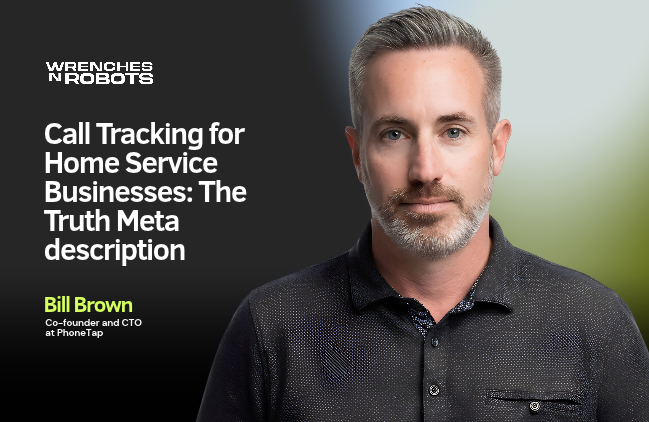
That uncomfortable truth is the heart of this episode of Wrenches n Robots. Tersh Blissett sat down with Bill Brown, co-founder of PhoneTap and a former HVAC contractor who ran his own residential service and replacement shop for over a decade before building the software. PhoneTap is call tracking for home service businesses done with AI: it reads your ServiceTitan call transcripts and tells you whether a call was a real lead, whether it booked, and the true reason it did not. What makes the conversation worth your time is not the product. It is the two of them being honest about the part of the business they both admit they failed at. The call center.
The call center is the black hole of home services
Both of them said it plainly: the call center has been the black hole of the trades for years. You hire someone, hand them the phones, and hope calls get booked. Then when business dips, you go looking for someone to blame, and it lands on the CSR. Bill described his own version of it: when the company was not doing well, he was looking for somebody to yell at, and it was going to be the CSRs. Tersh called it delegation by obligation, setting the result you want, refusing to train anyone on how to hit it, and then holding them accountable for a moving goalpost.
Bill's reframe cuts through it. If you cannot measure someone and you cannot train them, how accountable can you really hold them for the outcome? That is not a software problem. It is a leadership problem, and it is the reason accurate call data matters in the first place.
Why your booking rate is probably inaccurate
When Bill was running his shop remotely, living in Florida while the business was in Columbus, Ohio, he started pulling his booking rate apart step by step. He wanted to know exactly where each number came from, who entered it, and whether they could get it wrong. What he found is that his booking rate was not accurate, and the errors were not even consistent between CSRs.
So he asked a handful of other ServiceTitan contractors if he could look at 30 of their calls each. Same story every time. Booking rates were off, and the reasons attached to unbooked calls were all over the place. Some companies had 50 different unbooked reasons that all looked basically the same. Some had three. His conclusion was blunt: most contractors cannot look at the data they have about their phones and make a real decision from it. And the ones who felt confident had usually hired one or two people whose entire job was to listen to calls and classify them, and those were still not accurate, because a human brings bias. You give one CSR more grace than another because you like them better. AI does not care. It is black and white, and when a call genuinely sits in a gray area, it flags it instead of guessing.
That is the quiet case for call tracking software. Not that it replaces anyone, but that listening to and classifying every call takes longer than the calls themselves, it is brutally boring, and it is a job built for a robot. As Bill put it, no person wants to do this job.
Start by defining what a lead even is
Before you can trust any number, you have to define the thing you are counting, and Bill pointed out that the industry does not agree on what a lead is. A lot of owners think a lead is anything that cost them money, but that is ad spend, not a lead. His definition is clean: a lead is someone who contacts you with the intent to buy a service you actually provide, in an area you actually work, and who gives you the contact information to reach them. Anything else is not a lead.
It matters more than it sounds. If you cannot define a lead, a customer, and an opportunity, you cannot measure them, and you certainly cannot hold a marketing company accountable when there is no shared definition of success. From there, PhoneTap runs a simple decision tree on every call: is it a lead or not, did it book or not, and if it did not book, what was the real reason. Those reasons, like price shopping, decision maker pending, or a scheduling conflict, are where coaching and process changes actually live.
You can't hold a CSR accountable for what they can't control
Here is the nuance most incentive plans miss. A scheduling conflict counts against booking rate, but what is a CSR supposed to do when the schedule is full because a tech quit or because it is the hottest week of the summer? Nothing. So Bill's rule is that you only incentivize people on things they can actually control. You still want to know about the scheduling conflicts, because they tell you something about the business, but you do not punish the person on the phones for them.
That principle shows up in how he built the CSR scoreboard inside PhoneTap. It leans toward wins, not failures: objections won, booking streaks, the stuff that makes someone want to get better. It can show booking rate, but you can filter out the things CSRs cannot control, like scheduling conflicts, so the number is fair. And the AI agents are deliberately kept off the scoreboard, because if the AI does much better your team feels terrible, and if it does worse the owner feels terrible. Neither one drives the behavior you want.
What a customer is actually worth
The part that genuinely surprised Tersh was the math on customer value. A new customer for a PhoneTap contractor is worth about $1,600 in revenue in the first 12 months. Most owners have no number to compare that to. And if you told them a new customer was worth $1,600 in year one, they would assume an existing customer is worth $2,000 every year after. The opposite is true. After that first year, the additional revenue is often closer to a couple hundred dollars a year.
Bill walked through why. For an HVAC company, a homeowner might spend around $1,000 a year with you on average over 15 years, but that is not a smooth $1,000 a year. Roughly 75 percent of it comes at one moment in the cycle, the system replacement, and that usually happens in the first year you meet them, because people find you when their system is broken and out of warranty. After the big change out, there is simply not much left to sell unless they add other trades or more systems.
This is not an argument to ignore existing customers. Retaining them is easy and cheap, their trucks-in-the-neighborhood marketing works for you, and when they need the next system their lifetime value comes back around. The real lesson is to treat every single call like the $20,000 system change out it might be, because the data says the big money is at the start of the relationship, not spread out across it. Tersh told on himself here: the 6pm call he waved off because he was slammed could have been exactly that sale. And the customer he nurtured for six years, serviced twice a year, and never once asked for the sale, who then replaced the system with a competitor off a flyer, because nobody ever made the offer.
Build the playbook from calls you already won
The most useful systems idea in the episode is how Bill thinks about coaching. He is adamant that he is not a great CSR coach and will not pretend to hand you a script. Instead, he lets your own data find the script. AI is good at reading a transcript and pulling out objections, and flagging whether each one was won or lost. So instead of guessing, you ask a simple question: who in this company handles price shopping the best, and what exactly do they say?
He showed it with a real contractor. Price shopping was their number one unbooked reason, making up 43 percent of unbooked calls, which was hundreds of lost booking opportunities. The move is not to copy a best-practices script off the internet. It is to find the CSR who books 80 percent of their price-shopping calls, capture what they actually say, and make that the standard for the company, because it already works in your market with your customers. Then you train to it, change one thing at a time, let enough time pass, and measure whether it moved. As Bill said, the only thing you can do is make a single change and measure it. Change everything at once and you learn nothing.
The honest take on AI voice
Because this is a show about AI in the trades, AI voice came up, and the guidance was refreshingly direct. Do not tell your customer they are talking to an AI. Announcing it up front signals the opposite of what you want, that the thing is inflexible and might not be able to help, and in some regions, especially older and affluent neighborhoods, people simply hang up. There is a place for AI voice, but you have to be strategic about where you point it, because the penalty for getting it wrong is real. Every hung-up call could be a system replacement walking to a competitor.
What makes PhoneTap useful here is that it does not care which AI voice provider you use. It judges an AI agent exactly like it judges a human CSR, with no bias, which means it can show you honestly whether the voice tool you bought is actually performing or just overpromising.
The bottom line for owners
Call tracking for home service businesses is not about catching your CSRs doing something wrong. It is about finally having data you can trust, so you can coach with facts instead of frustration. Get an accurate booking rate, define what a lead actually is, stop penalizing people for things they cannot control, understand that most of a customer's value lands in year one, and build your playbook from the calls your best people already won. Do that and your booking rate climbs, which quietly lowers your customer acquisition cost and makes every marketing dollar work harder.
Want to see your own numbers? If you run ServiceTitan, PhoneTap will run a free demo on your real calls at phonetap.ai, no commitment. And to get every episode of Wrenches n Robots in your inbox, join the newsletter that around fifty thousand people in the trades already read.
Frequently Asked Questions
What is call tracking for home service businesses?
It is the practice of analyzing your inbound phone calls to see whether each one was a real lead, whether it booked, and why it did not. Done with AI, it reads call transcripts and classifies them consistently, giving you a booking rate and unbooked reasons you can actually trust.
Why is my booking rate inaccurate?
Because the data behind it is entered by people, and people are inconsistent. Unbooked reasons vary wildly between CSRs and companies, and manual classification carries bias. Even shops that hire someone to listen to calls full time usually end up with numbers that are not accurate.
How should I incentivize my CSRs?
Only on things they can control. A scheduling conflict when the board is full is not the CSR's fault, so it should not be held against them. Focus incentives and coaching on objections they can actually influence, like price shopping, and celebrate wins rather than only flagging failures.
What is a new customer actually worth?
In this episode, about $1,600 in revenue in the first 12 months for a typical HVAC contractor, with roughly 75 percent of a customer's lifetime value landing in that first year around the system replacement. Additional yearly revenue after that is often small, so treat every new call as a potential big-ticket sale.
How do I build a CSR coaching playbook?
Let your own call data find it. Identify the objection costing you the most bookings, find the CSR who overcomes it best, capture exactly what they say, and make that the company standard. Train to it, change one thing at a time, and measure whether your booking rate improves.