

AI Voice for Home Service Businesses: What Actually Works
Here is the quiet math that costs trades businesses the most money, and almost nobody tracks it. A call comes in while you are elbow deep in a job. It rings out. The customer hangs up and dials the next shop on the Google list. You never even knew the call happened.
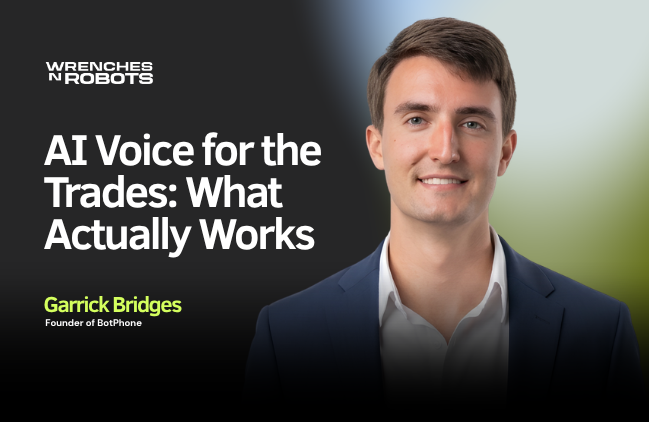
That is the exact problem AI voice is built to solve, and it is the subject of this episode of Wrenches n Robots. Tersh Blissett sat down with Garrick Bridges, founder of BotPhone, who builds fully managed AI receptionists for small businesses. What you get is not a pitch for replacing your team. It is a grounded look at where AI voice for home service businesses actually earns its keep, how to tell if it pays for your shop, and where the tech still falls short.
Voicemail is worse than no answer
Garrick opened with the stat that should change how every owner thinks about a missed call. Sending a caller to voicemail is worse than not getting the call at all. He backed it with two numbers. Most callers never leave a voicemail. They hang up and move straight to the next business on the list, which might be your competitor landing the job. And most customers buy from the first business that actually answers.
Put those together and a missed call is not a maybe. It is a lead you paid for walking directly to someone else. The point of an AI receptionist is not to be fancy. It is to make sure a human voice, or a capable AI one, picks up before that caller is gone.
Where AI voice actually belongs
This is where Garrick was refreshingly honest, and it lines up with the whole Wrenches n Robots standard. He would not put an AI voice in as your main receptionist today. If you have a human answering your phones, that human is still your best first point of contact. Full stop.
Where AI voice wins right now is the calls you are going to miss anyway. The 24/7 coverage. The call that comes in at 2am. The overflow when your team is already on the phone. An owner-operator with no one to answer is a clear fit. So is a shop bleeding after-hours leads. In those spots there is very little downside to turning on an agent that answers, qualifies, and either books the job or takes a message and hands it off. Garrick thinks that changes over the next five years, but that is the honest line today.
Tersh put the operator version of the same idea on the table. He loves automation and AI, and he still warns contractors against buying a tool just because it is new. On site, the first thing owners ask him is what can we automate. His answer is always a question back: what problem are you trying to solve. If you cannot name the pain, you are chasing a shiny object, not fixing your business.
How to actually measure the ROI
Most owners cannot tell you how many calls they miss in a week, which is exactly why the opportunity is invisible. Garrick breaks the math down to four inputs you can estimate: how many calls you get a month, what percentage you miss, your average job size, and your close rate on the calls you do answer.
Run it for a typical HVAC shop. Around 120 calls a month, missing somewhere between a third and 40 percent of them, an average job in the high hundreds to low thousands, closing about half of what gets answered. The revenue sitting in those missed calls adds up fast, into the thousands per month, and for some shops much more if the agent actually books the work. Garrick is careful not to oversell it, because an AI sales agent is not running gap selling or hammering the close. It reads from a knowledge base and gives back good information. But even as a floor, the number is usually enough to make an owner sit up, because it was never on a report anywhere.
This is a white glove service, not a toggle
One of the most useful reframes in the episode: a good AI receptionist is not a switch you flip. Garrick runs BotPhone as a managed service for a reason. Someone has to build the agent, keep up with models that change almost daily, make sure it has the right information, and keep it tuned. That is not work a busy owner-operator has time for.
So the real decision is not AI voice yes or no. It is whether you have someone technical enough on your team to own it, or whether you are better off with a managed group that lives in this every day. Garrick compared it to hiring a web design or marketing agency. The tech is only as good as the person keeping it sharp, and a tool nobody maintains becomes a tool nobody uses.
He also stacked it against the after-hours answering services a lot of shops already pay for. Those run around a thousand dollars a month, do not cover you around the clock, usually just take a message, and often cannot book a job. Tersh knew the pain firsthand, from services that got his company name wrong or sounded like they just rolled out of bed. His bar was low and telling: even an AI voice wins if it gets the company name right and sounds awake.
Be upfront, and protect the brand
The part that should calm the nerves of any owner worried about customer backlash is how Garrick leads with transparency. He does not hide the AI. He has it give callers the options right at the start, including asking whether this is an emergency, and routes true emergencies straight to a list of real people while capturing the details so the team can respond fast.
Tersh made the consumer case cleanly. Even if he did not want to talk to an AI, an agent that says it can either book him now or have a human call back within the hour puts his mind at ease, because he knows he is not getting dropped. That is the difference between an AI that erodes trust and one that protects it. Being upfront is not a weakness. It is how you earn the room to let the tool do more over time.
The honest limits
Both of them were clear that this is not a silver bullet, and contractors are always hunting for one. AI voice does not handle rebuttals or an argumentative caller well yet, and it does not run sales tactics or keep asking for the close. As Tersh put it, the call center has been the black hole of the home service industry for years, the place you hire someone, feed them to the wolves, and hope calls get booked. AI voice is a massive improvement on that, but it still needs you to measure it, review it, and check that it is doing what you want.
Garrick's own call center past drove it home. At a large moving company, 50 to 60 calls a day went to a callback queue, and when they called those people back 10 to 30 minutes later, only 10 to 20 percent even answered. More than half of those had already booked with someone else. Speed is everything, and an agent that captures and qualifies the lead the moment it comes in is how you stop handing that revenue to the competition.
The bottom line for owners
AI voice for home service businesses is no longer a gimmick, but it is also not a magic receptionist. The owners who win with it start with a real problem, usually missed and after-hours calls, point the tool only where it clearly helps, keep a human in the loop where it counts, stay upfront with callers, and actually measure the result. Do that and you stop losing leads you already paid for. Treat it as a shiny object and you will join the pile of shops that signed up and never used it.
Want to hear what a managed AI receptionist sounds like, or run your own missed-call math? You can reach Garrick and BotPhone at botphone.tel. And to get every episode of Wrenches n Robots in your inbox, join the newsletter that around fifty thousand people in the trades already read.
Frequently Asked Questions
What is AI voice for home service businesses?
It is an AI-powered receptionist that answers inbound calls, screens spam, qualifies leads, and can book appointments into your calendar or CRM. For trades shops it is used most to cover the calls a human would otherwise miss, especially after hours and during overflow.
Should AI voice replace my receptionist?
Not today. If you have a human answering calls, they are still your best first point of contact. AI voice is best deployed as backup for missed, after-hours, and overflow calls, where the alternative is a lost lead.
How do I measure ROI on an AI receptionist?
Estimate four things: your monthly call volume, the percentage you miss, your average job size, and your close rate on answered calls. Multiply through and you get a rough picture of the revenue sitting in missed calls, which is usually the hidden number that justifies the tool.
Can AI voice book jobs in ServiceTitan or Housecall Pro?
Yes. These agents can integrate with major field service and CRM platforms like ServiceTitan, Housecall Pro, and GoHighLevel, and even work alongside simpler setups. The right integration depends on your stack.
Will customers be annoyed by an AI answering?
Some callers, especially older ones, are wary at first. The way to protect your brand is to be upfront, give callers clear options at the start, and route emergencies straight to a human. An agent that promises a fast human callback keeps people from feeling dropped.