

AEO for Home Service Businesses: How to Get Found When Customers Ask AI
For twenty years, getting found meant one thing: rank on Google. Shops poured money into SEO, learned the game, and mostly knew where they stood. Then the ground moved. Over the last year or so, a lot of contractors watched their search results slide for no obvious reason, and nobody could quite say why.
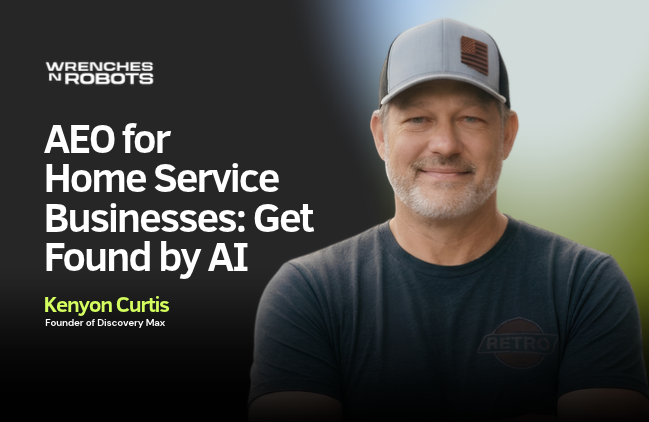
This episode of Wrenches n Robots is about what actually changed. Tersh Blissett sat down with Kenyon Curtis, founder of Discovery Max, who builds a done-for-you AI visibility service. The topic is AEO, answer engine optimization, which is the practice of getting your business recommended when a customer asks an AI instead of typing into Google. It is not a doom story about search dying. It is a grounded look at the shift and what a shop can actually do about it.
The number behind the shift
Kenyon put a figure on why this matters now. Around 4.5 billion monthly searches are happening on AI. That is not a rounding error. When a chunk of your customers start their research inside ChatGPT or Gemini instead of Google, and you have only ever optimized for Google, you are invisible to all of it.
Tersh framed the stakes the way an owner feels them. It is exciting if you are into AI. It is terrifying if your entire lead flow depends on Google SEO. Some of that slide is just Google changing its algorithm, as it always has. But a real part of it is customers moving their questions to AI, and that is the part most shops have not adjusted for.
AEO is not the enemy of SEO
Here is the reframe that should take the pressure off. Optimizing for AI does not mean tearing down your SEO. Done right, Kenyon says, AEO actually makes your SEO work better. The two reinforce each other.
His recommended starting point is a hard look at both. Run an AI visibility check to see where you stand in AI answers right now, what is working and what is not. Then run an honest SEO check alongside it, including how much you are spending. In a lot of cases, moving some of that SEO budget into AEO ends up improving both, because the same work that makes AI cite you also strengthens how you show up in traditional search. You are not picking a side. You are feeding two channels at once.
Write for the question, not the keyword
The most practical takeaway for any shop doing its own content is how AEO changes writing. For years, SEO was a keyword game. AEO is a question game. As Kenyon put it, your content needs to be written as if it is answering a question. A little more conversational, structured around what a customer would actually ask.
That means updating your FAQs, writing blogs that answer real questions directly, and optimizing your Google Business Profile with the same mindset. Instead of hunting for keywords, you are finding the questions you need to rank for. A good tool watches what people are actually asking in your category and surfaces those questions, then figures out what is making your competitors show up so you can close the gap. Same instinct as long tail keywords, pointed at a new target.
What to look for in an AI visibility tool
Tersh asked the question every owner should ask: what makes one of these tools different from the next. Kenyon drew a clear line between two kinds of product. One kind just monitors. It tells you how you are doing and hands you a list of things to go fix yourself. The other kind is done for you, where the service actually does the work once it is turned on.
A few things stood out as worth looking for. Coverage across many engines, not just ChatGPT, because there are a growing number of LLMs that people use, from Gemini to Perplexity and beyond. Keeping your business information clean across the hundreds of citation sites that feed AI answers. And watching for AI hallucinations about your business, the confidently wrong answers AI sometimes gives, like telling someone to go to a restaurant that is closed that day. If an AI is going to describe your shop to a customer, you want it describing you correctly, and you want it ranking you against real competitors rather than your own suppliers.
Keep your head on straight
Both of them were refreshingly level about the hype, which is exactly the Wrenches n Robots standard. Kenyon has watched the whole spectrum, from people who want to ignore AI entirely to people who think the world ends tomorrow if they do not optimize. His own advice, which he says he put right in the book he wrote, is to ignore the SEO is dead headlines. Those are written to get a click. The real move is to stay educated and aware, not panicked.
Tersh put the operator version plainly. Do not let AEO become the shiny object that pulls you away from the real fires in your business. We all have the fear of missing out. But if you dive so deep into AI search that you ignore the things actually breaking in your shop, you have made it worse, not better. The win is getting the balance right, treating AI search as one real channel to tend, not a five alarm emergency.
What getting started looks like
For owners wondering about the timeline, Kenyon set expectations honestly. Standing up an AEO plan is a lot like SEO. It takes around 90 days to really get rolling, though you start to see some effect before that. The difference he points to is visibility into the work. Instead of waiting until the end of the month for a report you may not even understand, a good platform gives you a daily read on where you rank, what is working, and where you need to improve, and keeps making adjustments in the background.
That measurement mindset is the thread through the whole conversation. There has to be a real return, time saved, money saved, or revenue created. AI search is only worth doing if it moves one of those, and the way you know is by watching the numbers, not the headlines.
The bottom line for owners
AEO for home service businesses is not a reason to panic or to throw out your SEO. Customers are moving their questions to AI, so the shops that win will show up in those answers the same way they learned to show up on Google. Start by checking where you stand in both, write for the questions your customers actually ask, pick a tool that does the work and covers more than one engine, and keep enough perspective to tend your real business at the same time. Do that and AI search becomes a channel you own instead of one that quietly passes you by.
Want to see where your business stands in AI search right now? Discovery Max offers a free AI visibility audit at discoverymax.ai. And to get every episode of Wrenches n Robots in your inbox, join the newsletter that around fifty thousand people in the trades already read.
Frequently Asked Questions
What is AEO, and how is it different from SEO?
AEO, or answer engine optimization, is the practice of getting your business recommended inside AI-generated answers from tools like ChatGPT, Gemini, and Perplexity. SEO is about ranking on a search results page. AEO is about getting named in the answer itself, before the customer ever reaches a list of links.
Does optimizing for AI hurt my Google rankings?
No, not when it is done right. The work that helps AI engines cite you, like clearer question-and-answer content and clean, consistent business information, tends to strengthen your traditional SEO at the same time. The two channels reinforce each other.
How do I write content for AI search?
Write as if you are answering a question. Make your content a little more conversational, update your FAQs, and structure blogs around the real questions customers ask about your service. The goal is to rank for questions, not just keywords.
How long does AEO take to work?
Plan for about 90 days to really get rolling, similar to SEO, though you often see some early effect before that. Look for a tool that gives you a daily read on where you rank rather than a once-a-month report.
What should I look for in an AI visibility tool?
Coverage across multiple AI engines rather than just ChatGPT, help keeping your business information clean across the many sites AI pulls from, monitoring for AI hallucinations about your business, and ranking that compares you to real competitors. Decide too whether you want a tool that only monitors or one that does the work for you.
Watch the full episode on YouTube. Want help putting AI to work in your shop? Book a call.